Gas vs Electric Snow Blower: Which One Should You Buy?
Electric snow blowers suit you if easy upkeep and a quieter machine matter most, while Popular Mechanics points buyers with deep, wet snow on large properties toward bigger gas machines. Electric models need no oil or gasoline, and battery models start with a button. They have limits, though. Cold is a weak spot for batteries, and a flat one takes hours to recharge.
As an Amazon Associate I earn from qualifying purchases.
Quick answer
Choose Gas snow blowers if
you clear deep, wet snow on a large property, or single-digit and below-zero days are routine where you live; Popular Mechanics leans gas for both and keeps cordless machines for small or medium properties with storms of about a foot or less.
Choose Electric snow blowers if
your property and your storms fit that cordless range, and you'd rather skip oil, gasoline and a louder engine.
In this guide
Comparison table
Scroll sideways to see every column.
| Feature | Gas snow blowers | Electric snow blowers | Edge |
|---|---|---|---|
| Maintenance | Fuel care plus engine upkeep | No oil or gasoline | Electric snow blowers |
| Starting | Pull cord; many add electric start | Push button | Electric snow blowers |
| Run time | 1.0 hr continuous (Honda HS720) | Up to 70 min (Toro Power Max e24) | Depends |
| Cord | — | Corded models: gauge by cord length | Depends |
| Heavy or wet snow | Disputed; see below | Varies by model and battery count | Depends |
| Noise | Louder | Quieter (battery models) | Electric snow blowers |
| Storage | Drain or stabilize fuel | Remove the battery | Electric snow blowers |
1. Maintenance: gas needs more upkeep
A gas snow blower needs more upkeep than an electric one, with fuel care and engine maintenance. An electric machine has no oil to check and no gasoline to keep at home. Battery models are easier to maintain. On the gas side, the Honda HS720 single-stage needs a new spark plug every 150 hours of use. Electric isn't care-free, though: the battery still needs looking after when the season ends.
Fuel and off-season storage
Gasoline goes stale when it sits, and a stabilizer slows that down. Toro's advice is to buy only the fuel you'll use in 30 days and add stabilizer the day you buy it, one ounce per two gallons, which it says keeps fuel fresh for at least 12 months. Before the off-season, drain or stabilize the fuel. On a battery machine, take the battery out instead. Whichever you own, store it somewhere dry.
EdgeElectric snow blowers.There's no oil to check and no gasoline to treat or drain.
2. Starting: battery machines start with a button
Battery snow blowers start with the push of a button. Gas machines start with a pull cord, though many also offer push-button electric start. On a cold day, an electric starter makes starting easier than a pull cord. The corded SJ627E starts with a push button, and its start type is electric.
Cold mornings
Batteries have their own cold problem. The EGO SNT2400 may not start properly when its battery is at -4°F (-20°C) or colder. Picture a 6 a.m. storm in a deep freeze, with work to get to. That's the number to keep in mind before you count on a battery machine.
EdgeElectric snow blowers.Battery machines start with a button, while gas needs an electric-start model to do the same.
3. Run time: sources and figures disagree
Run time is where the sources and the published figures part ways. Popular Mechanics says gas blowers can run longer, since you only refill the tank when it's nearly empty. The published figures are 1.0 hr of continuous use for Honda's gas single-stage HS720 and up to 70 minutes for Toro's battery two-stage Power Max e24. The Honda figure varies with snow depth and weight. Toro's single-stage Power Clear e21 runs up to 45 minutes.
Recharging and my battery picks
A flat battery means a long wait: both Toro battery models have a 180-minute charge time. Neither of my battery picks publishes a run time per charge. The 24V-X2-SB22 page gives only a recharge time, and the SNT2134 page gives no charge time. EGO rates the SNT2134 for up to a 14-car driveway with 8 in of snow on a single charge with two recommended 6.0 Ah batteries.
The 24V-X2-SB22 battery setup
The 24V-X2-SB22 draws 48 V from two 24 V batteries of 8.0 Ah each. Each battery peaks at 24 V at full charge with no load, and its nominal voltage under typical load is 21.6 V. The model also works with the IONMAX 24-Volt battery system.
EdgeDepends.The published figures don't hand either side a clear win, and a flat battery means hours on the charger.
4. Power for heavy snow: the sources split
Sources split on raw clearing power. Consumer Reports says gas machines still clear snow faster, while Popular Mechanics found a battery SnowMaster as capable as its gas twin. On the battery side, the setup matters. The EGO SNT2134 runs on Peak Power, which combines two recommended EGO 56 V batteries. The EGO SNT2400 shouldn't run on a single battery when snow tops 8 inches or is very wet.
Brand differences on wet snow
Brands differ on whether wet snow needs two batteries: EGO pairs two for heavy, wet snow, while Toro lists heavy and wet snow for its single-battery Power Clear e21. Toro's Power Max e24, which ships with 2 batteries, has Heavy, Wet as its snow type. Both Snow Joe picks move up to 840 lb of snow per minute. The corded SJ627E's snow type is light and fluffy, on paved surfaces.
How my picks are built
The SNT2134 and the 24V-X2-SB22 are both single-stage machines. The SJ627E's stage isn't given; its drive system is Auger Assisted. All three use steel augers: steel on the EGO, all steel on the SJ627E, and a 4-blade, rubber-tipped steel auger on the 24V-X2-SB22. The 24V-X2-SB22 has a 1600 W brushless motor, and the SNT2134 also has a brushless motor.
EdgeDepends.Whether gas clears faster is disputed, and on the battery side it comes down to the model and its batteries.
5. Noise: battery models run quieter
Battery snow blowers tend to run quieter than gas models. Gas machines are the louder option, and battery models produce no exhaust. If you clear the driveway at 6 a.m. before work, with houses close on both sides, this is the point to weigh.
EdgeElectric snow blowers.Battery models tend to run quieter and produce no exhaust.
Which one should you buy
Buy electric if it fits your snow and your lot, and start with these three, in this order.
Best battery pick
 On Amazon
(paid link) 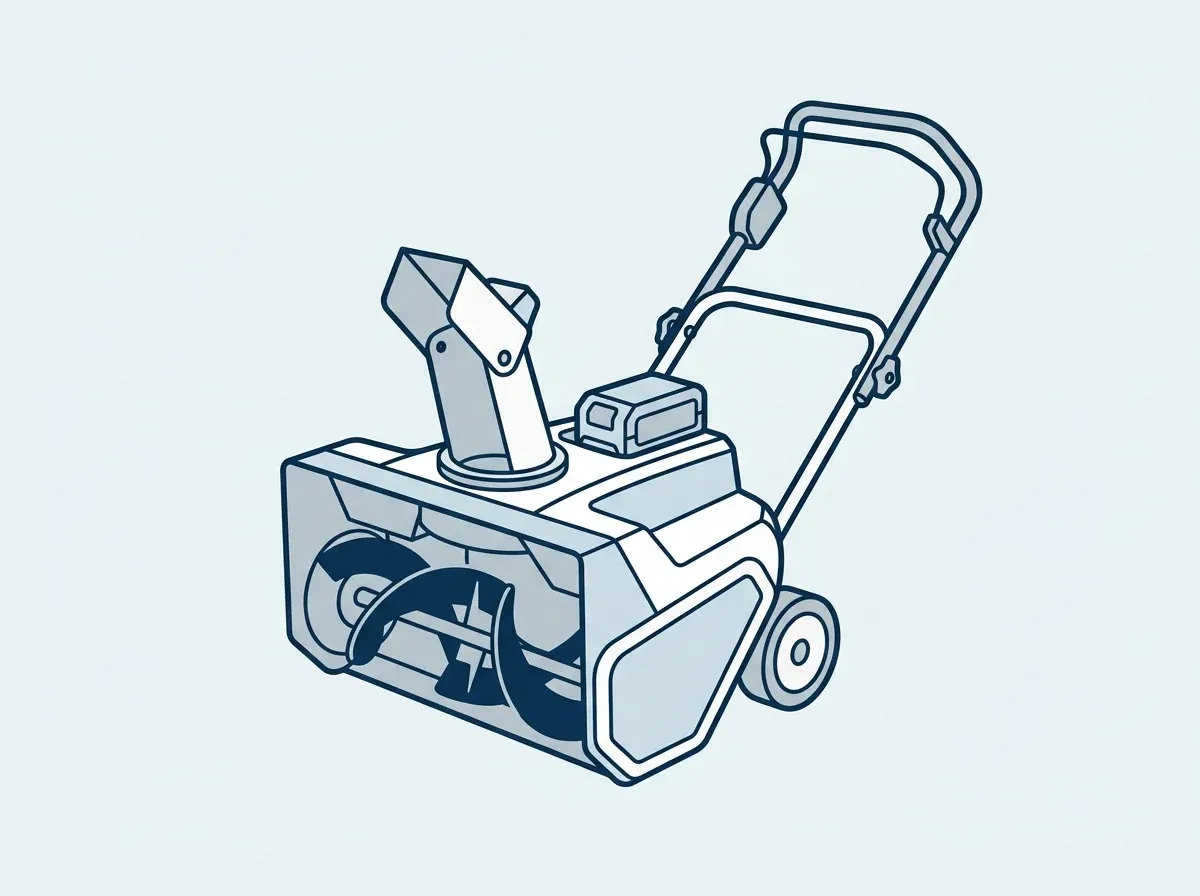
Illustration EGO Power+ SNT2134
It throws snow up to 45 ft with 200 degrees of directional control, against 25 ft on both Snow Joe models, and adds heated handle grips, a steel auger, two 6.0 Ah batteries in the kit and a 5-year tool warranty (3 years on the batteries).
Check price on Amazon(paid link)
Widest battery pick
 On Amazon
(paid link) Illustration Snow Joe 24V-X2-SB22
Its 22 in by 13 in path is wider than the EGO's 21 in, its kit includes two 24 V 8.0 Ah batteries and a dual-port charger, and it weighs 45.2 lb with batteries installed.
Check price on Amazon(paid link)
Best corded pick
 On Amazon
(paid link) 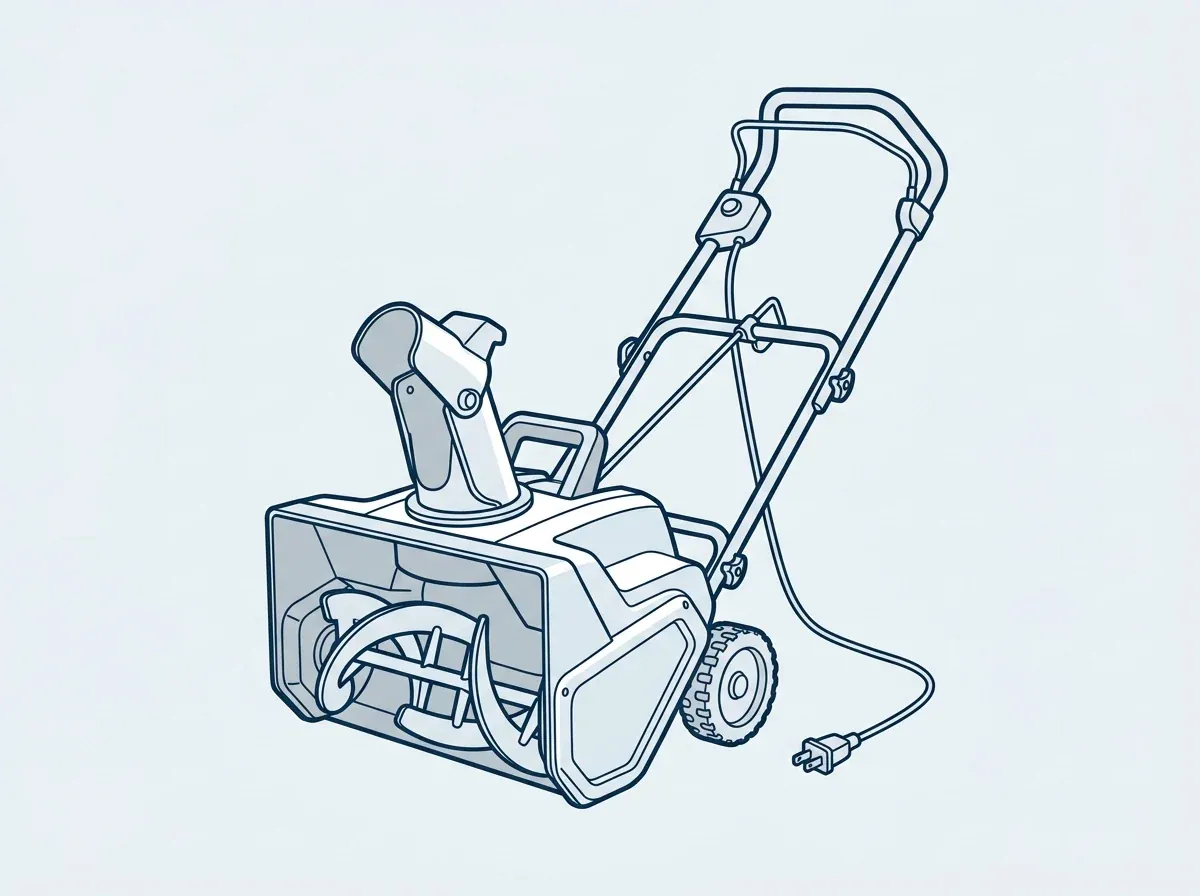
Illustration Snow Joe SJ627E
It pairs a corded 15 A, 120 V motor with an all-steel auger, push-button start, dual LED headlamps and the same 22 in by 13 in path as the 24V-X2-SB22, backed by a 2-year tool warranty.
Check price on Amazon(paid link)
How I picked
I compared 14 products in detail and read 39 sources: manufacturer product pages and FAQs, manufacturer buying guides, and Consumer Reports, Popular Mechanics and Bob Vila buying guides.
FAQ
Can a corded snow blower use any extension cord?
No, a corded snow blower needs a cord heavy enough for its length. The SJ627E calls for 14 AWG cord up to 50 ft and 12 AWG from 50 to 100 ft. Toro's corded 1800 Power Curve takes 16 AWG up to 100 ft and 14 AWG up to 150 ft. On the SJ627E, an undersized cord causes a voltage drop, which means lost power and overheating.
Maximum length differs by source: Toro's corded manual allows up to 150 feet, while Snow Joe's SJ627E manual and Consumer Reports put the limit at 100 ft.
Do batteries lose power in the cold?
Yes, batteries lose performance in the cold. EGO's 56V batteries charge best between 41°F and 104°F (5°C and 40°C). They shouldn't be stored where the temperature drops below -4°F (-20°C).
Can I use E15 gasoline in a gas snow blower?
No, not in a Toro engine. E15, gasoline with 15% ethanol, isn't approved for Toro engines, while up to 10% ethanol is acceptable. For other brands, check the engine's manual.
How much storage space does a snow blower need?
It varies by model. Toro's gas Power Clear 821 QZE has storage dimensions of 33 x 21 x 34 in. Its battery Power Clear e21 comes in at 27.1 x 22.4 x 25.4 in.
Sources
- Consumer Reports
- Popular Mechanics
- Bob Vila
- Snow Joe (SJ627E and 24V-X2-SB22 product pages, SJ627E operator's manual)
- EGO (SNT2134 product page, EGO website, SNT2400 operator's manual)
- Toro (product pages and website, Toro Advantage, 1800 Power Curve operator's manual)
- Honda Power Equipment (HS720 owner's manual)
- Husqvarna
More guides
- Best electric snow blowerFive corded and battery models compared on clearing width, throw distance, run time, weight and warranty.
- Best snow blower for womenFive picks ranked by weight, how they start and whether they drive themselves.
- Single-stage vs two-stage snow blowerHow each type moves snow, and which one fits your snow depth and driveway surface.
- Snow Joe snow blower reviewThree Snow Joe models, one corded and two battery, compared on maker specs.
- Greenworks snow blower reviewTwo Greenworks 60V single-stage models compared on maker specs, with what each page leaves out.
- Snow blowers for heavy snowFive battery picks compared on stages, intake height, throw distance and battery kit.
- Snow blower for a gravel drivewayFour two-stage battery picks and one single-stage, with what each maker says about gravel.
- Electric snow shovel vs snow blowerClearing width and depth, throw distance, weight, snow type and surface, with two shovel picks and two blower picks.