Snow Blower vs Shovel: Which One Fits Your Winter?
A snow blower suits frequent or heavy snowfalls and large areas, while a shovel is enough for short driveways, walkways and shallow snow. Your body matters here too. Health research on shoveling flags both the heart and the back. Sources disagree on how much a blower helps, so I've laid out both sides. After that, I name four blowers worth a look.
 By Alex M. · Published · Updated
As an Amazon Associate I earn from qualifying purchases.
Quick answer
Choose Snow shovels if
your driveway is short or you mostly clear walkways, and your snowfalls usually stay under about 4 to 6 in.
Choose Snow blowers if
your snowfalls are frequent or heavy, often run deeper than that, or cover a large driveway.
In this guide
Key takeaways
- Heavy shoveling is hard on your heart. In research cited by the American Heart Association, heart rate passed 85% of maximum after two minutes of shoveling.
- Whether a blower is easier on the heart is disputed. The American Heart Association favors an automated snow blower over a shovel, while to Harvard Health, pushing a heavy snow blower can strain the heart the same way.
- Push snow instead of lifting it. Several health groups give that advice for your back, and lifting with your legs is the fallback when you can't avoid lifting.
- There's no agreed depth cutoff. The figures sources give for switching from a shovel to a blower run from 4 in to about 6 in of snow.
- A shovel wins on upkeep. It needs little to no maintenance, while snow blowers require maintenance.
Comparison table
Scroll sideways to see every column.
| Feature | Snow shovels | Snow blowers | Edge |
|---|---|---|---|
| Effort | Hard on heart and back | Easier on the heart, but disputed | Snow blowers |
| Snow depth | Shallow snowfalls | Deeper snow; figures vary by source* | Snow blowers |
| Driveway size | Short driveways, walkways | Larger areas | Depends |
| Wet or heavy snow | Heavy to lift; clear early | Varies by machine and source | Depends |
| Maintenance | Little to none | Needs maintenance | Snow shovels |
| Storage | Very little space* | About a walk-behind mower (single-stage gas)* | Snow shovels |
| Noise | Fine for early mornings* | Over 90 dBA at the ear (gas)* | Snow shovels |
*Snow depth: figures differ by source and machine; Snow depth and type below gives them. Storage and noise: a tradesman quoted by Tom's Guide for shovels, Consumer Reports for single-stage gas blowers (storage) and gas blowers (noise).
1. Effort and strain on your body
Heavy shoveling is hard on both your heart and your back. How a blower compares is less settled.
Your heart
In research cited by the American Heart Association (AHA), heart rate passed 85% of maximum after two minutes of shoveling, and in an analysis cited by Corewell Health, ten minutes of heavy shoveling averaged 97% of the maximum reached on a treadmill. Cold adds to that strain.
In a Canadian study, deeper snow went with more heart attack admissions among men. To Harvard Health, though, the study can't prove shoveling is the cause.
The AHA advises an automated snow blower over shoveling, citing heart rates around 120 versus around 170 and still urging caution, while Harvard Health says pushing a heavy snow blower can strain the heart the same way. That's a real split, so I won't pretend a blower settles it.
Your back
The back takes the most shoveling injuries. Sprains, strains and cuts are among the most common. Several health groups give the same advice: push snow instead of lifting and throwing it. When lifting can't be avoided, lift with your legs.
An ergonomic shovel, with a curved or bent handle, is designed to cut down on bending. If a shovel is your main tool, that's the kind I'd reach for.
EdgeSnow blowers.The heart-rate figures above favor a blower, even with the dissent noted.
2. Snow depth and type
Deeper snow favors a blower. Where a shovel stops being enough depends on who you ask.
How deep is too deep for a shovel
A GreenPal co-founder quoted by Tom's Guide says a snow blower is best once snow is deeper than 4 in, while Consumer Reports calls about 6 in a depth you'd easily tackle with a good shovel. If your storms usually land between those two figures, it's your call.
Sources differ on how deep single-stage electric and battery blowers clear: by Consumer Reports' count most single-stage battery models max out at about 6 in, though some reach 9, while Snow Joe's smaller single-stage electric and cordless models are listed for up to 8 in, and its larger ones for up to 12 in.
Then there are two-stage machines. Consumer Reports gives a compact two-stage up to about a foot, wet or dry, and Toro suits two-stage blowers to snowfalls of 12 in or more.
Check your own winters against those numbers.
Wet, heavy snow
With a shovel, clear wet, heavy snow early and often rather than leaving one big job.
Blowers are less settled. Toro calls its single-stage machines a great pick for wet, slushy snow, and EGO says the single-stage SNT2134 can clear even the heaviest, wettest snow, while Consumer Reports says single-stage models have more trouble the wetter the snow gets at depths near 9 in. The SJ627E is listed for light, fluffy snow. The Snow Joe 24V-X2-SB18's plowing capacity may vary with snow conditions.
EdgeSnow blowers.Two-stage machines and Snow Joe's larger single-stage models go past both shovel figures.
3. Driveway size
A shovel suits a short driveway or a walkway. Larger areas are where a snow blower pays off. A blower also finishes the job in less time.
In one comparison on a 4-inch snowfall, posted on a Low Technology Institute wiki page, clearing about a ton of snow took 14:00 minutes with a gas snowblower, 18:27 with a snow scoop and 25:00 with a shovel. That's one storm and one test, so treat it as a rough guide.
Gravel driveways
Gravel advice depends on the machine. The SJ627E is listed for paved surfaces. Consumer Reports calls single-stage gas blowers a poor choice for gravel and says two-stage blowers are best there because the auger doesn't touch the ground, Greenworks does not recommend its single-stage throwers on gravel, and EGO says the SNT2134's skid shoes are adjustable for improved performance on gravel and irregular surfaces.
Path and throw on the four picks
The SJ627E cuts the widest path of the four at 22 in, followed by the SNT2134 at 21 in, the Snow Joe 24V-X2-SB18 at 18 in and the Greenworks at 16 in. The SNT2134 throws farthest, up to 45 ft. The SJ627E throws up to 25 ft, and the Greenworks has a maximum throwing distance of 25 ft. The Snow Joe 24V-X2-SB18 throws up to 20 ft.
None of the three battery picks gives a run time in minutes.
EdgeDepends.Short driveways and walkways suit a shovel, and larger areas suit a blower.
4. Storage and maintenance
A shovel needs little to no maintenance. A snow blower needs maintenance.
Batteries and charging on the picks
The three battery picks come with chargers in their kits. The Greenworks runs on a 40V 5.0 Ah battery, and that removable battery powers over 100 Greenworks 40-Volt tools. Its charge time is listed as 150 minutes.
The Snow Joe 24V-X2-SB18 runs on two 24 V batteries for 48 V, and its kit holds two 4.0 Ah batteries.
The SNT2134 kit includes two 6.0 Ah batteries, and no charge time is given for it. The corded SJ627E has no battery to charge; its 15 A motor is rated 120 V.
Cold and storage
The Greenworks battery and charger should always be stored indoors at room temperature. The battery's voltage output may be reduced if its internal temperature drops below -17°C. On the Greenworks, the upper handle also folds for more compact storage.
EdgeSnow shovels.On upkeep alone, little to no maintenance beats a machine that needs it.
5. Noise
Noise matters most at the hours you clear snow. Picture a 6 a.m. storm before work on a street that's still asleep.
A tradesman quoted by Tom's Guide calls shovels a great choice for early mornings when you don't want to make a lot of noise, and in a hearing-protection Q&A on gas-powered blowers, Consumer Reports says its testers have taken at-ear readings of more than 90 dBA while using snow blowers.
EdgeSnow shovels.On noise, the two sources above point the same way.
Which one should you buy
If the answers above point you to a blower, here's where I'd start, from the lightest to the pick for heavier snow; if they point to a shovel, the back advice above is your buying guide.
Lightest pick
 On Amazon
(paid link) 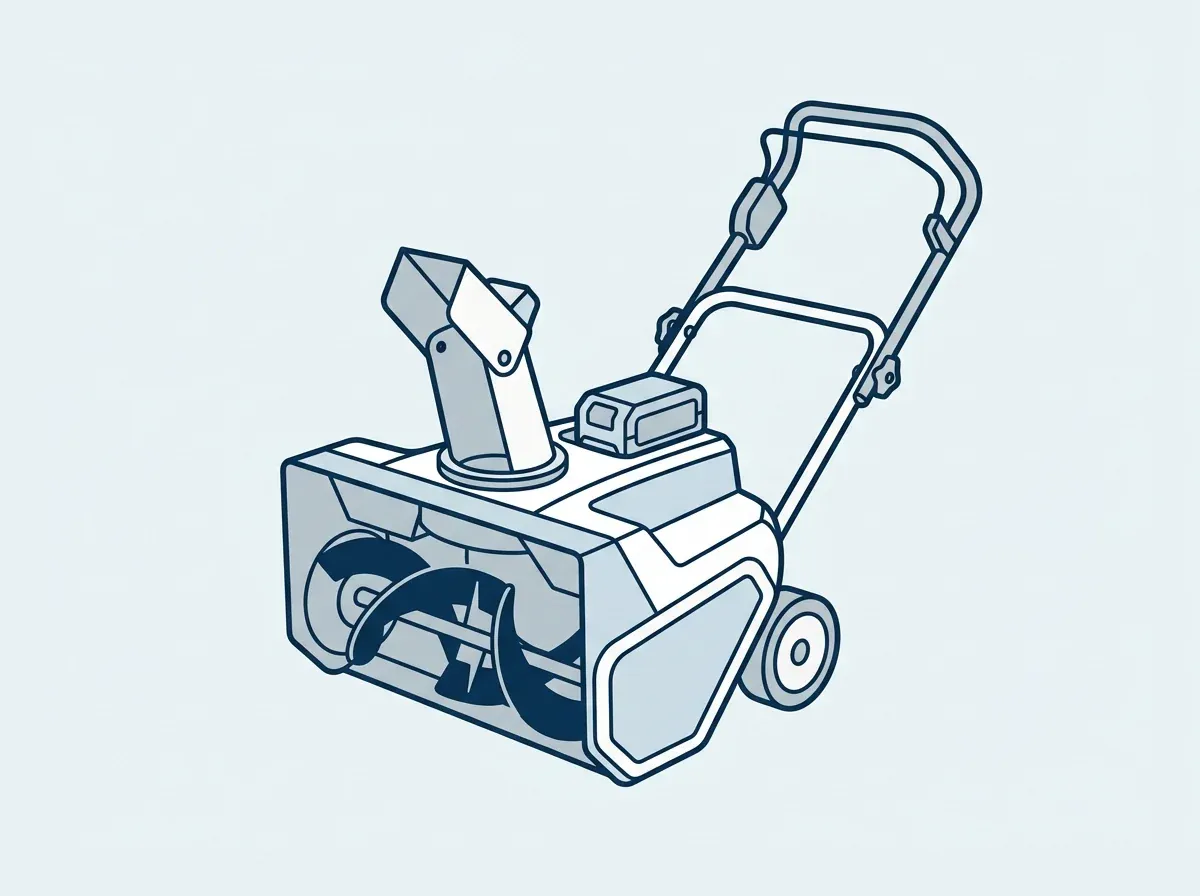
Illustration Greenworks 40V 16-Inch Cordless
It has the narrowest path here at 16 in and the lowest listed weight, 28 lbs with the battery, plus a folding upper handle and a 3-year limited warranty on the tool and battery.
Check price on Amazon(paid link)
Best 18-inch pick
 On Amazon
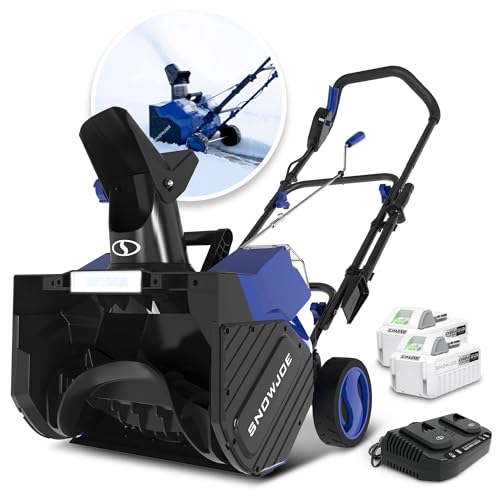
(paid link) Illustration Snow Joe 24V-X2-SB18
It clears an 18 in by 10 in path and throws up to 20 ft, with two 4.0 Ah batteries, a dual-port charger, a 2-year warranty and a listed kit weight of 29.45 to 29.54 lb (the page gives three figures).
Check price on Amazon(paid link)
Best corded pick
 On Amazon
(paid link) 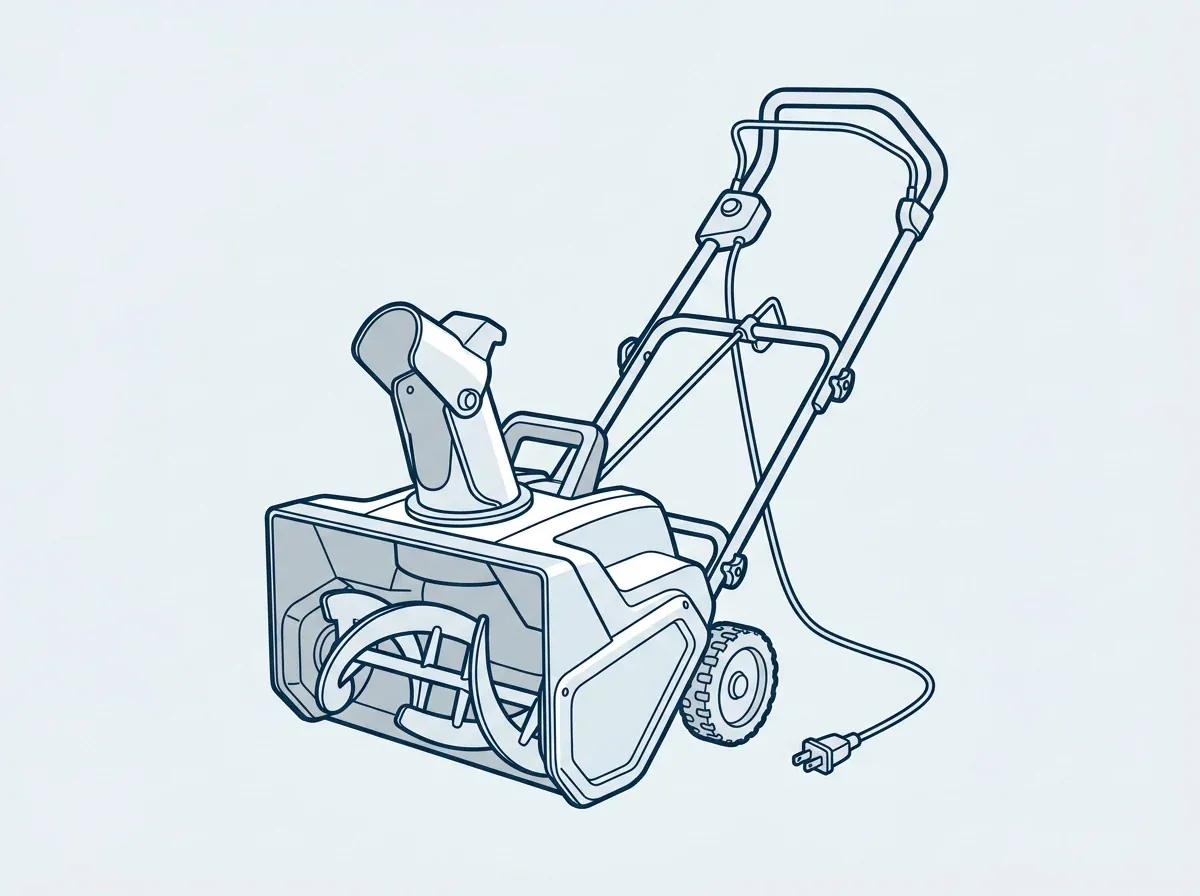
Illustration Snow Joe SJ627E
It pairs a corded 15 A motor with a 22 in by 13 in path, a throw of up to 25 ft, an all-steel auger and push-button start, and it's listed for light, fluffy snow on paved surfaces.
Check price on Amazon(paid link)
Pick for heavier snow
 On Amazon
(paid link) Illustration EGO Power+ SNT2134
It pairs a 21 in by 13 in path and a throw of up to 45 ft with a steel auger, two 6.0 Ah batteries and a 5-year tool warranty, with 3 years on the batteries.
Check price on Amazon(paid link)
How I compared snow blowers and shovels
I compared 21 products in detail and read 55 sources. They include the American Heart Association, Harvard Health, Nationwide Children's Hospital, the American Academy of Orthopaedic Surgeons, the Consumer Product Safety Commission, manufacturer pages and buying guides, and Consumer Reports and This Old House guides.
I compared shovels and snow blowers on five points:
- Effort and strain: what shoveling does to your heart and back, and how a blower compares.
- Snow depth and type: how deep and how wet the snow gets.
- Driveway size, including gravel, and how wide and far the picks clear and throw.
- Storage and maintenance, including batteries and charging on the picks.
- Noise, for early-morning clearing.
Every figure on this page comes from a source listed below, so you can check it.
I've used all four blower picks; what they're like in use is further down.
What they're like in use
I've used all four, at my dad's, my brother's or friends' places. Here's what stood out.
- Greenworks 40V 16-Inch Cordless. It's small and light enough to carry, and the upper handle folds, so it's easy to put away. It's narrow, though: a bigger driveway takes more passes.
- Snow Joe 24V-X2-SB18. It's light to push, but its narrow path means more passes on a full driveway. The batteries charged in about 2 hours.
- Snow Joe SJ627E. It starts on a button and handles light snow on pavement well; the cord is the catch, since you have to keep track of it.
- EGO Power+ SNT2134. It threw snow far, easily past the edge of the driveway, and it was much quieter than a gas blower.
FAQ
When is a snow blower worth it?
A snow blower is definitely for you, by Consumer Reports' measure, if you get three or more big snowstorms a year and can't afford to wait for a plow service. Below that, the depth and driveway points above should decide it.
Who should not shovel snow?
A heart expert quoted by the American Heart Association puts it plainly: people with cardiovascular risk factors, and anyone who has had bypass surgery or coronary angioplasty, should not shovel snow in any conditions. If you have a medical condition or don't exercise regularly, check with your doctor before you shovel. Hiring someone to clear the snow is an alternative several health groups suggest.
How do you clear a clogged snow blower safely?
Turn the snow blower off and clear the clog with a clean-out tool or a solid object, never your hands. Hand injuries, including finger amputations, turn up in both federal safety data and an emergency department study of snow blower use.
Is an ergonomic snow shovel better for your back?
It's designed to be. Its curved or bent handle is meant to cut down on bending and back strain, and to Nationwide Children's Hospital, ergonomically designed shovels are a great choice to reduce bending and heavy lifting. Pair it with pushing the snow instead of lifting it, the advice several health groups give.
Do you still need a shovel if you own a snow blower?
Yes. Consumer Reports calls a good shovel a winter essential even for blower owners, because some spots can't be reached with a blower and others, like a narrow walkway or a wooden deck, are overkill for one.
Should you use a snow blower if you have heart problems?
If you have a medical condition, check with your doctor before you shovel or snow blow, as the American Academy of Orthopaedic Surgeons urges. The American Heart Association has also pointed to studies showing a higher heart attack risk among people using automatic snow blowers, and to how quickly pushing one can raise heart rate and blood pressure.
How many people get hurt clearing snow?
The counts differ by scope. A Nationwide Children's Hospital study counted about 11,500 shoveling-related emergency department cases a year from 1990 to 2006, while the American Academy of Orthopaedic Surgeons cites a CPSC count of more than 137,000 people treated in emergency rooms, doctors' offices and clinics in 2018 for shoveling or snowblower injuries.
Sources
- American Heart Association
- Corewell Health (William Beaumont University Hospital)
- Harvard Health Publishing
- CMAJ (Canadian Medical Association Journal)
- U.S. National Weather Service
- Nationwide Children's Hospital
- Cleveland Clinic
- American Academy of Orthopaedic Surgeons
- U.S. Consumer Product Safety Commission
- American Journal of Emergency Medicine
- Outdoor Power Equipment Institute (press release via StreetInsider)
- Consumer Reports
- This Old House
- Tom's Guide
- Ariens
- Cub Cadet
- Toro
- Low Technology Institute
- Snow Joe product pages
- Greenworks product page
- EGO product page
More guides
- Best electric snow blowerFive corded and battery models compared on clearing width, throw distance, run time, weight and warranty.
- Best snow blower for womenFive picks ranked by weight, how they start and whether they drive themselves.
- Single-stage vs two-stage snow blowerHow each type moves snow, and which one fits your snow depth and driveway surface.
- Gas vs electric snow blowerMaintenance, starting, run time, power for heavy snow and noise, side by side.
- Snow Joe snow blower reviewThree Snow Joe models, one corded and two battery, compared on maker specs.
- Greenworks snow blower reviewTwo Greenworks 60V single-stage models compared on maker specs, with what each page leaves out.
- Snow blowers for heavy snowFive battery picks compared on stages, intake height, throw distance and battery kit.
- Snow blower for a gravel drivewayFour two-stage battery picks and one single-stage, with what each maker says about gravel.
- Electric snow shovel vs snow blowerClearing width and depth, throw distance, weight, snow type and surface, with two shovel picks and two blower picks.
- Compact electric snow blowersFour small models, 16 to 20 inches wide, compared on clearing width, weight, storage and corded or battery power.
- Snow blower vs snow throwerWhether the two names mean the same machine, what the makers call their own models, and how single-stage and two-stage machines move snow.
- Corded vs cordless snow blowerRun time, extension cords and outlets, weight, cold weather and warranty, with two corded and two cordless picks.
- EGO vs Greenworks snow blowerBattery platforms, warranty, clearing width and throw, two-stage options, and weight and storage, with two picks from each brand.
- EGO SNT2405 vs SNT2416Two 24-inch EGO kits compared on batteries, clearing width, throw, controls and warranty.